If you've ever opened your birth chart and felt lost in the wheel divided into twelve slices, those slices are the houses — and they're the part of astrology that finally makes the rest click into place.
Here's the simplest way to think about it. The planets show what energy is at play. The zodiac signs show how that energy expresses itself. And the houses show where in your life it actually unfolds — love, money, career, home, or your inner world. Once you understand the houses, your whole chart starts to read like a story about you, not a random scatter of symbols.
This guide walks through all twelve houses one by one, in plain language.
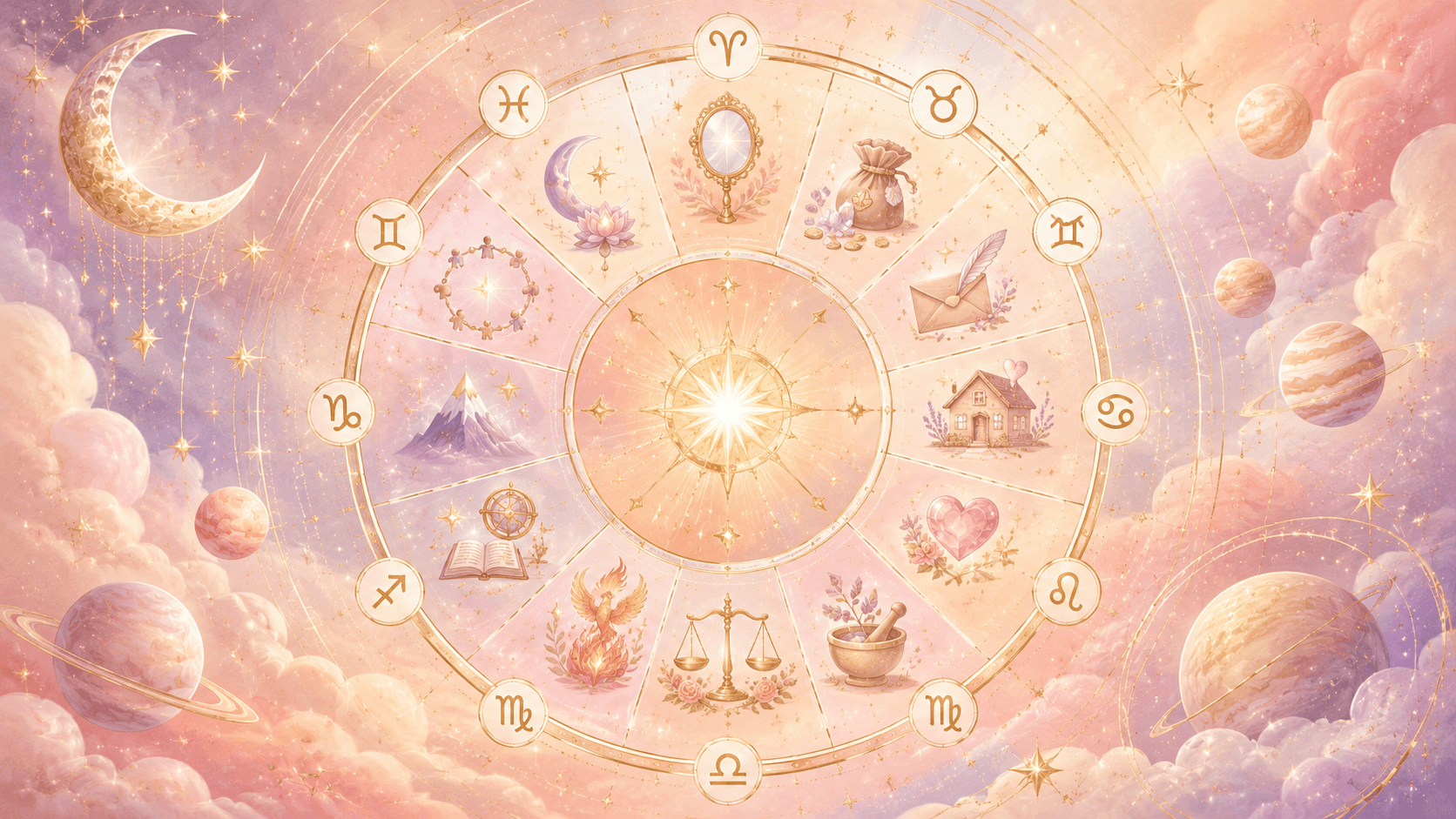
What Are the Houses in Astrology?
The birth chart is a 360° wheel — a snapshot of the sky at the exact moment and place you were born. That wheel is divided into twelve segments, and each segment is a house that rules a specific area of life.
Unlike the zodiac signs, which are tied to the position of the Sun across the year, the houses are tied to the rotation of the Earth — which is why your exact birth time matters so much. Two people born on the same day but a few hours apart can have completely different houses lit up.
The house sitting on the eastern horizon at your birth becomes your 1st House, and it's anchored by your rising sign. From there, the chart unfolds counter-clockwise through all twelve.
Signs, Planets, and Houses: The Three Layers
The easiest way to keep the building blocks straight is with a simple theatre analogy:
- Planets are the actors — they do something (Venus loves, Mars fights, Mercury talks).
- Signs are the costumes — they shape the actor's style and personality (Mars in Aries acts boldly; Mars in Pisces acts gently).
- Houses are the stage — they decide where the scene takes place (the bedroom, the office, the family home).
So a planet in a sign in a house reads like a sentence: this energy, expressed this way, in this part of your life. If you want to see which planets land where in your own chart, start with the birth chart guide and the planets overview.
The Four Angles: The Backbone of the Chart
Before the houses themselves, it helps to know the four angles — the most powerful points in the entire chart. They mark the cusps of four key houses:
- The Ascendant (ASC) — the cusp of the 1st House. Your outward self, the mask you meet the world in.
- The Imum Coeli (IC) — the cusp of the 4th House. Your roots, home, and private foundation.
- The Descendant (DSC) — the cusp of the 7th House. Partnership and the qualities you seek in others.
- The Midheaven (MC) — the cusp of the 10th House. Your public reputation, career, and life direction.
Planets sitting near any of these angles tend to be loud, defining features of your personality.
The 12 Houses, One by One
Each house has a natural ruling sign and planet that share its themes. Your personal chart may have different signs on each house, but these natural associations are the foundation.
1st House — Self & Identity
- Natural ruler: Aries / Mars
- Keywords: appearance, first impressions, vitality, the body, how you start things
This is you — your personality, your physical body, and the energy you project before you say a word. The sign on this house is your rising sign, one of the most personal points in the chart.
2nd House — Money & Values
- Natural ruler: Taurus / Venus
- Keywords: income, possessions, self-worth, security, what you value
The 2nd House covers your material world — how you earn, spend, and build security — but also your deeper sense of self-worth and what truly matters to you.
3rd House — Communication & Mind
- Natural ruler: Gemini / Mercury
- Keywords: thinking, speaking, writing, siblings, short trips, everyday learning
This house rules how your mind works and how you connect with your immediate world — conversations, messages, neighbours, and the small daily journeys that shape your routine.
4th House — Home & Roots
The most private corner of the chart. The 4th House describes your inner emotional base — your upbringing, your sense of belonging, and the home you build for yourself.
5th House — Creativity & Joy
This is the house of joy and creation — falling in love, making art, having fun, and letting your authentic self shine without apology.
6th House — Work & Wellness
- Natural ruler: Virgo / Mercury
- Keywords: daily routine, health, habits, service, work, self-care
The 6th House is the everyday — your schedule, your job (the work itself, not the career title), your health practices, and the small habits that keep your life running.
7th House — Partnership
- Natural ruler: Libra / Venus
- Keywords: marriage, committed relationships, business partners, one-to-one bonds
Ruled by the Descendant, this house describes your closest partnerships and the qualities you're drawn to in others. To explore how two charts interact, try a compatibility reading.
8th House — Transformation
- Natural ruler: Scorpio / Pluto
- Keywords: intimacy, shared resources, rebirth, the hidden, deep change
One of the most intense houses. The 8th rules deep transformation — emotional and physical intimacy, shared finances, and the cycles of endings and beginnings that reshape us.
9th House — Beliefs & Expansion
- Natural ruler: Sagittarius / Jupiter
- Keywords: higher learning, travel, philosophy, faith, the big picture
This is the house of meaning and adventure — long journeys, higher education, spiritual beliefs, and the search for a wider truth beyond your everyday world.
10th House — Career & Reputation
- Natural ruler: Capricorn / Saturn
- Keywords: career, public image, ambition, achievement, legacy
Anchored by the Midheaven, the 10th House shows your place in the world — your professional path, your reputation, and what you want to be known for.
11th House — Community & Dreams
- Natural ruler: Aquarius / Uranus
- Keywords: friendships, networks, groups, hopes, long-term goals
The 11th House is about your wider circle — friendships, communities, and the future you're building toward, often alongside like-minded people.
12th House — The Inner World
- Natural ruler: Pisces / Neptune
- Keywords: the subconscious, solitude, spirituality, healing, what's hidden
The most mysterious house of all. The 12th rules the unseen — dreams, intuition, the subconscious, time alone, and the quiet spiritual work that happens behind the scenes.
Angular, Succedent, and Cadent Houses
The houses also fall into three groups that describe how they operate. This is a quick way to read the rhythm of any chart:
- Angular houses (1, 4, 7, 10) — the action houses. They initiate and define. Planets here are powerful and visible.
- Succedent houses (2, 5, 8, 11) — the stability houses. They build, hold, and resource what the angular houses begin.
- Cadent houses (3, 6, 9, 12) — the adaptation houses. They process, learn, and prepare for the next cycle.
How to Find Your Houses
To map the houses accurately, you need three pieces of information:
- Your date of birth
- Your exact time of birth (this is what sets the house cusps)
- Your place of birth
Without a birth time, the houses can't be calculated reliably — though your planets and signs still tell you plenty. You can set everything up with the birth chart guide and read more about how the wheel is divided on the houses page.
One thing worth knowing: there are several house systems astrologers use to slice the wheel — the most common are Placidus, Whole Sign, and Equal House. They can place a planet in slightly different houses, so if two charts disagree, the house system is often why.
What About Empty Houses?
If a house has no planets in it, don't panic — an empty house is completely normal. You only have ten planets (including the Sun and Moon) to spread across twelve houses, so at least two will always be empty.
An empty house simply means that life area isn't a major focal point of your chart — not that it's missing or broken. You read it through the sign on its cusp and the planet that rules that sign instead.
Bringing It All Together
Once you know the houses, reading a chart becomes a conversation between three layers: a planet (the what), in a sign (the how), in a house (the where). Start small — find where your Sun, Moon, and rising sign land, notice which houses are most crowded, and let the story build from there.
The cosmos isn't asking you to memorise everything at once. Take one house at a time, and your chart will keep revealing itself.
Frequently Asked Questions
How many houses are there in astrology?
There are twelve houses, each governing a different area of life — from identity and money to relationships, career, and the subconscious.
Do I need my exact birth time for the houses?
Yes. The house cusps are set by the Earth's rotation, so your exact birth time determines which house each planet falls into. Without it, the houses can shift dramatically, although your signs and planetary placements remain accurate.
What does an empty house mean?
An empty house is normal and not a negative sign. With only ten planets to fill twelve houses, several will always be empty. That life area is simply less of a focal theme, and you interpret it through the sign on its cusp.
What's the difference between a sign and a house?
A sign describes the style of an energy (bold, gentle, practical), while a house describes the area of life where it shows up (home, career, love). Planets, signs, and houses work together to form the full picture.
Written & reviewed by
Elena
Founder of Elunna Mystic. Each article is written and reviewed for accuracy. More about the author →